Flying boot
Roadside PicnicThe Flying boot is a vehicle used to enter and cross the Zone, but its significance lies in more than transportation: it carries people across a boundary that is physically guarded and scientifically regulated, then uses a built-in mechanism to repeat the route back out. During Redrick Schuhart and Kirill Panov’s expedition, it makes the contrast between a hazardous human undertaking and automated, reproducible movement unusually clear. The vehicle is at once indispensable equipment and evidence that entering the Zone does not mean mastering it.
Arrival and institutional setting
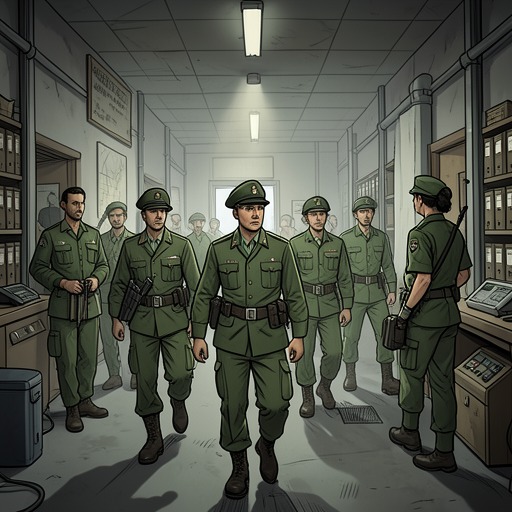
The Flying boot waits at the passageway when Redrick and Kirill prepare to enter the Zone. It has been brought there by the PPS personnel, and a lieutenant, a first-aid team, firemen, guards, rescuers, and a helicopter are also waiting. The arrangement turns the expedition into a highly visible institutional procedure: the researchers put on special suits, submit their passes, and cross the institute yard toward the Zone entrance with an escort assembled to deal with an emergency. The boot is therefore not simply private transport. Its availability and use belong to a managed expedition, surrounded by access checks, protective equipment, and official supervision.
That formal apparatus sits in pointed contrast with the vehicle’s actual work. Redrick treats the rescue personnel with contempt and makes a sardonic remark about the public image of scientists laying down their lives for humanity and knowledge. The boot, however, is a concrete necessity within the performance: it carries the expedition through a landscape whose hazards cannot be handled by ordinary vehicles or ordinary procedures. The surrounding safeguards make the danger legible without making it controllable.
The Zone itself is visible from behind the institute’s thick, leaded windows, close enough to seem within reach. The view includes an industrial town, but no living or dead people; a long, open-doored garage resembles a gray intestine, and trucks stand on the paved lot beside it. That eerie emptiness sharpens the boot’s role: the vehicle is a means of entering a place whose familiar industrial forms remain, even as the human world that gave them meaning has vanished. Access is possible, but the landscape does not become ordinary because it can be approached.
The expedition with Redrick and Kirill
At the passageway, Kirill takes the controls while Redrick leads the operation. Redrick gives precise instructions to lower the visors, travel slowly along the pylons at a height of three yards, and stop at the twenty-seventh pylon. Kirill raises the boot to the specified altitude and proceeds in low gear. Their exchange establishes a division of labor: Kirill pilots, while Redrick directs the route and the expedition’s immediate movements.
The boot’s controlled speed and height matter because the expedition depends on carefully managed approach rather than a straightforward drive. Redrick later directs Kirill to move at the lowest speed toward a nut on the ground and stop two feet away. When Kirill asks whether Redrick is looking for graviconcentrates, Redrick declines to let the proposed name settle the matter, saying he is looking for what he should be looking for. The scene connects the vehicle’s measured handling to the uncertainty of Zone exploration: exact positioning is possible, but identifying the object or knowing what it means remains a separate problem.
The vehicle thus supports a particular kind of work. It can be maneuvered to a specified point and held there, allowing Redrick to investigate objects at close range, but it does not supply the knowledge needed to interpret them. The boot makes the expedition’s physical procedures more precise without resolving the deeper uncertainty that defines the Zone. Its technology controls movement; it does not convert the strange into the understood.
The automatic return mechanism
On the journey back, the Flying boot does not require the same active piloting. Redrick explains that it has a mechanism he tentatively calls a coursograph, which controls the vehicle and drives it along the course taken on the way in. As it floats back, it repeats the expedition’s maneuvers, pausing and hovering at the same points before continuing. The outbound route is therefore stored in the vehicle’s operation and replayed in reverse as a practical return path.
This return function changes the significance of the route. The way out is not improvised independently: the boot reproduces the approach, including its stops and movements, so that a return can follow a track already tested during entry. The feature makes the vehicle seem almost self-directing, yet its autonomy remains bounded by the expedition’s prior course. It can repeat what has been done; the account does not suggest that it independently evaluates the hazards or chooses a safer alternative.
Redrick contrasts this convenience with the difficulty of getting into the Zone. He observes that the scientists work in daylight and that the hardest part is entering; on the way back, the boot drives itself. The contrast is wry rather than reassuring. Automated return may ease one part of the expedition, but it does not cancel the danger of crossing the boundary or of approaching the Zone’s objects in the first place. Indeed, the boot’s replay of the route emphasizes how much the team depends on the path they have already taken.
A vehicle within an uncertain material world
The Flying boot belongs to a broader landscape where naming, possession, and comprehension do not coincide. Redrick’s encounter with an object he calls a nut, and Kirill’s question about graviconcentrates, show how readily a recognizable label can be proposed before its meaning is secure. Elsewhere, researchers are said to have learned how to use so-so devices and even to understand the circumstances in which they multiply through a process resembling cell division, while still lacking a full understanding of their relation to the fruit they produce. That gap between practical use and explanation frames the boot’s own role: effective handling is not the same as knowledge of the Zone as a whole.
Its automatic mechanism also sets up a quiet tension between technological confidence and environmental uncertainty. The boot can maintain a precise height, move slowly, stop near an object, and later retrace a sequence of maneuvers. Those capacities are exact and useful, but their precision remains local. The vehicle can follow an established line through the Zone; it cannot make the Zone transparent, restore the absent people of the industrial town, or guarantee that a familiar-looking object has been understood. Its most impressive feature is repetition, not mastery.
The boot consequently links the Zone’s restricted geography to the procedures by which outsiders enter it. Passes, suits, escorts, pylons, measured movement, and automated return form a chain of controls around an environment that resists complete control. As a vehicle, the Flying boot moves the expedition across that boundary. As a narrative device, it makes the limits of that movement visible: the team can enter, act, and retrace its path, while the Zone’s underlying nature remains unresolved.